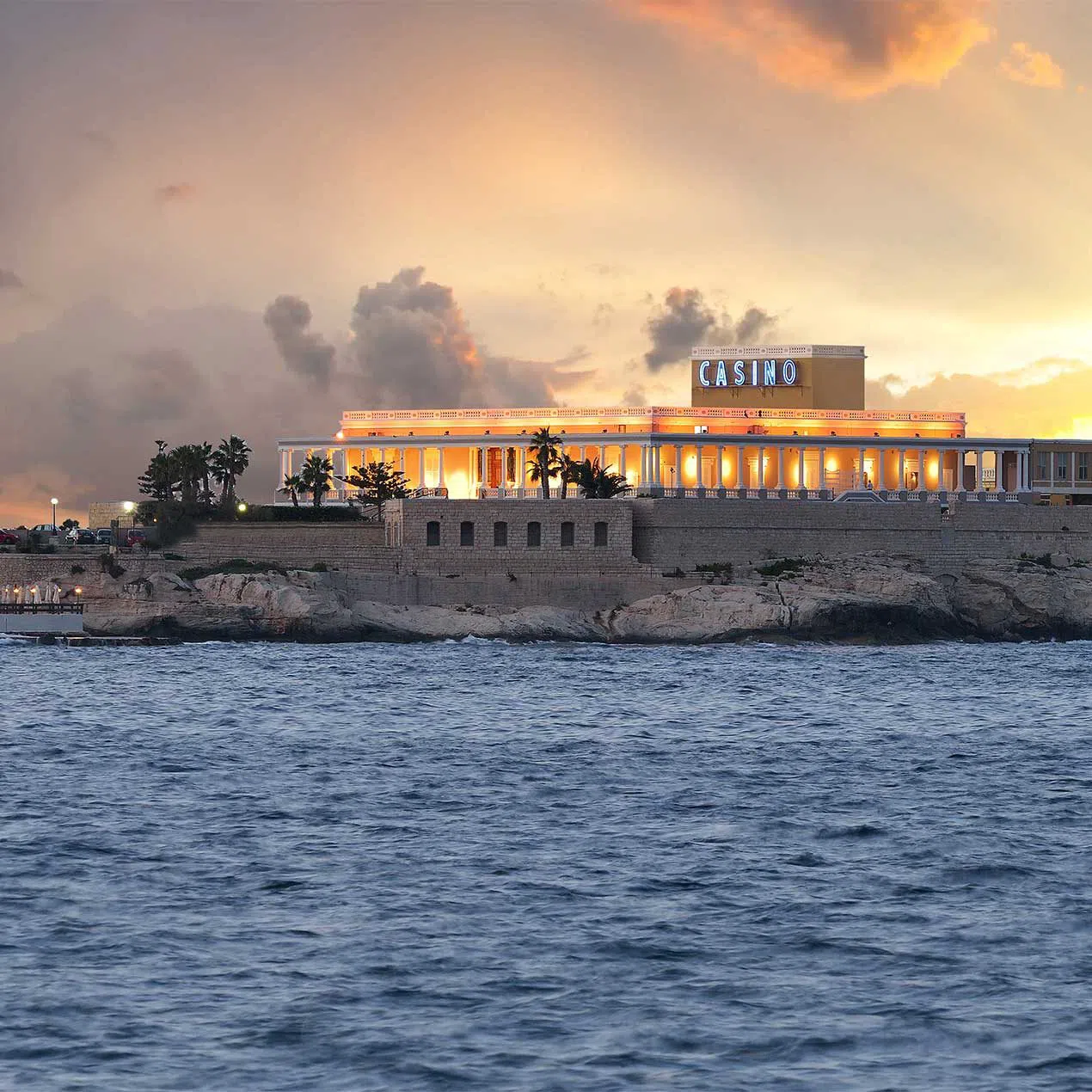

The Marquis Scicluna's summer palace on the Dragonara headland opened as Malta's first casino on 15 July 1964, and within three years a Hilton stood a few hundred metres down the shore. St Julian's had about a decade to stop being a fishing village and start being a resort, and it did the job in the order the sea allowed: casino first, paid bathing terraces next, hotels planted on the rocks, dance floors behind them, British records arriving by ship and by serviceman. This walk follows that sequence along roughly two kilometres of waterfront, from the headland to Balluta Square. Very little of the original fabric survived the 1990s, and the walk says where.
The palace that became a casino
Start on the Dragonara headland at the north end of the bay, because everything else in this article is downstream of one address. Dragonara Casino (Dragonara Point) occupies the summer palace the Scicluna family built on the promontory in the nineteenth century. The Marquis leased it to the Kursaal Company, the tables opened in July 1964, and the effect on the shoreline was immediate: a reason for foreign visitors to come to this particular bay rather than any other, and a reason for hoteliers to buy the rocks around it.

You can walk in without paying. There is no entry fee, drinks run roughly €8–14 and table minimums start at about €5, so a look at the rooms costs nothing beyond a glass. Two practical points matter more than the gaming. First, identification: you will be asked for an ID card or passport on a first visit, foreign nationals must be 18 or over, and Maltese nationals must be 25 or over. Second, dress: smart casual is expected and beachwear will not get past the door. Groups are taken freely, but the ID check happens one person at a time at a desk, so a stag or hen party of fourteen should expect to queue, and should expect anyone who left their passport in the room to be turned away at the front. Couples and pairs have an easier evening of it.
A paid terrace instead of a beach
What the 1964 arrivals actually did with their days was lido culture, and St Julian's still has one working example of it. The Reef Club Lido at The Westin Dragonara Resort (Dragonara Point) sits on the same Scicluna headland as the casino: a rock-cut bathing terrace with metal ladders into deep water, loungers rented by the day, a bar and food service behind. There is no sand here and there never was. The 1960s coast sold organised access to the water rather than a beach, and this is the closest thing still trading on that arrangement.
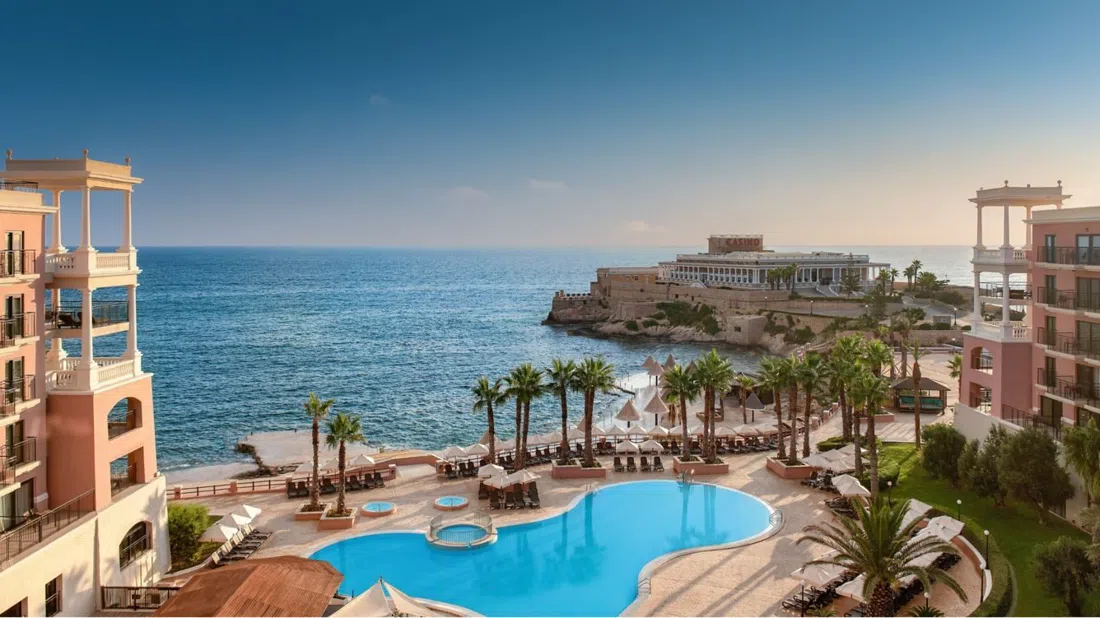
Day passes are sold to non-residents, which is what makes it usable if you are staying elsewhere on the strip. Expect €40–45 per person for the pass, or €60–65 with a €25 food and drink credit attached, which is worth the arithmetic if you intend to eat lunch there anyway. Family rates are available. The club is seasonal, roughly late May into autumn, opening at 09:00 or 09:30 and closing between 18:00 and 19:00 depending on the month. Reserve ahead in July and August; the loungers go. It suits a group that wants one base for a whole day, and it is the wrong choice for anyone who pictured walking into the sea off sand.
What stands where the Hilton stood
Walk south off the headland and the next landmark is the one that announced the package-holiday era. Hilton Malta (Portomaso) stands on the exact site of the original Malta Hilton of 1967, the first international-chain hotel on the island and the signal that charter flights were coming. Be clear about what you are looking at, though: the 1967 building was demolished in the 1990s, along with the British-era remains of Fort Spinola on the same ground, to make way for the Portomaso development and its marina and tower. The hotel you book is the successor, not the survivor.
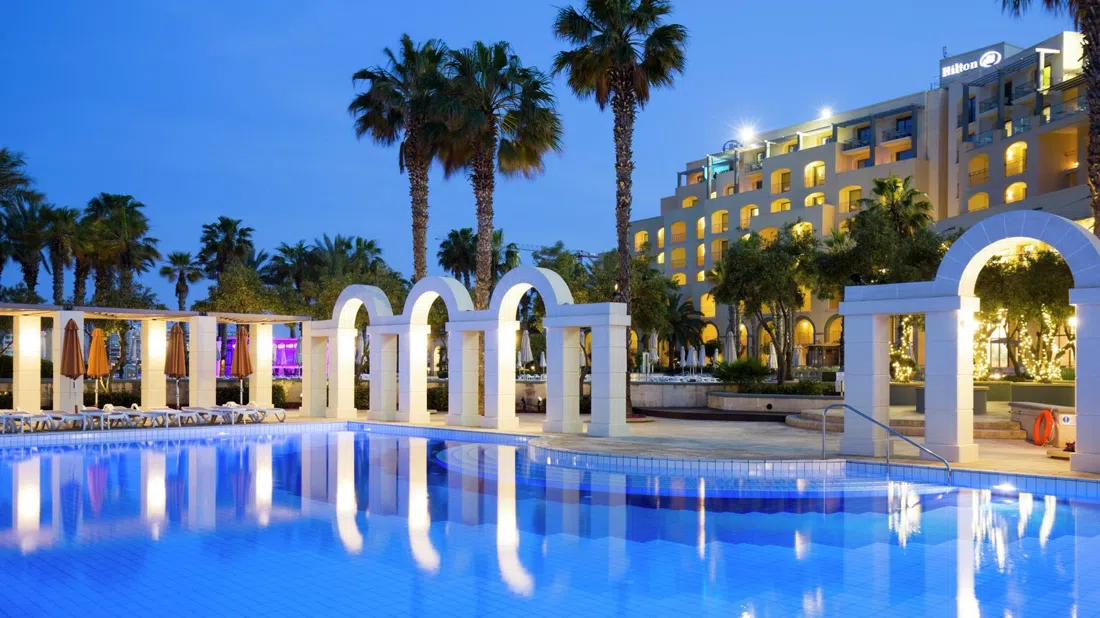
As a place to stay it is built for volume: 410 rooms, 31 suites and a full conference centre, which is why coach blocks and corporate groups end up here by default. Rates run about €120–350 a night depending on season. If you are weighing it against the smaller properties further round the bay, compare them side by side in the St Julian's hotel search before you commit to the bigger building; the walk from Portomaso to Balluta is about twenty-five minutes, so position genuinely changes your week.
Round Spinola Bay on foot
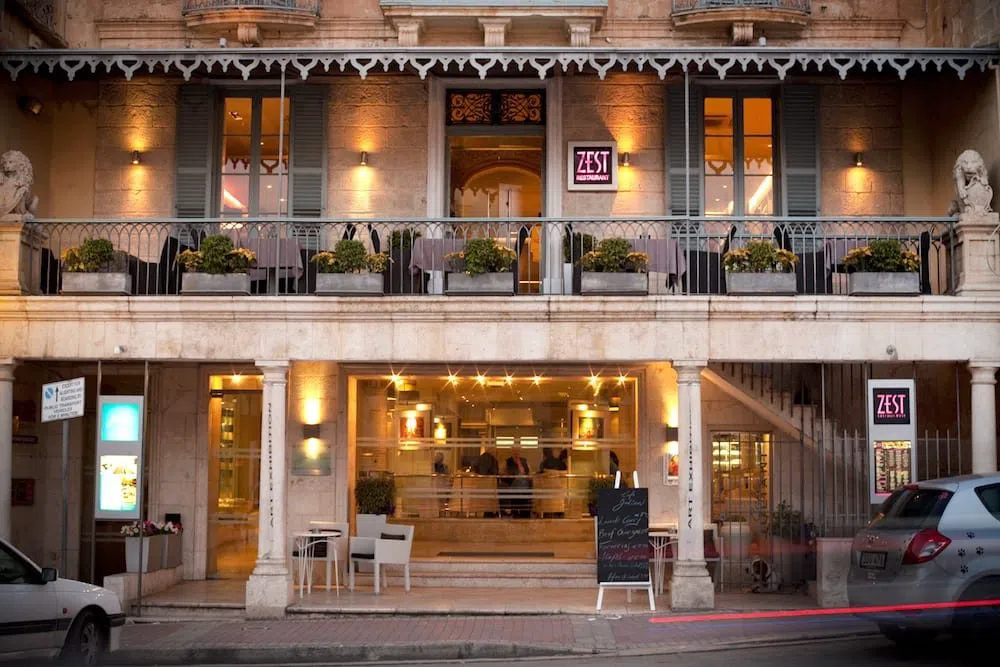
From Portomaso the promenade bends inland into Spinola Bay, where the fishing boats still moor and the pre-boom scale of the village is briefly legible. Hotel Juliani (Spinola Bay) is the one address on this route that is an actual survivor rather than a replacement, a townhouse of the kind that lined the bay before the towers, now running as a boutique hotel of 44 rooms. It bills itself as Malta's first boutique hotel. Rates sit around €120–280 a night. Forty-four rooms means it works for a couple or a group of six and does not work for a coach party; the rooftop and the Zest restaurant can be booked for private events, which is the way larger bookings use it.
A few minutes on, Cavalieri Hotel Malta, a member of Radisson Individuals (between Spinola and Balluta) is worth noticing for its stance as much as its rooms. It is planted directly on the rocks rather than set back behind a road, which is the logic the early resort hotels followed: get the guests onto the water, then build whatever you can fit behind them. Note the name. It was known for years simply as the Cavalieri Art Hotel and half the web still lists it that way, so search both. It is a mid-size four-star with two restaurants and indoor and outdoor pools, €70–200 a night, comfortable for a tour group and not the right room for a large party.
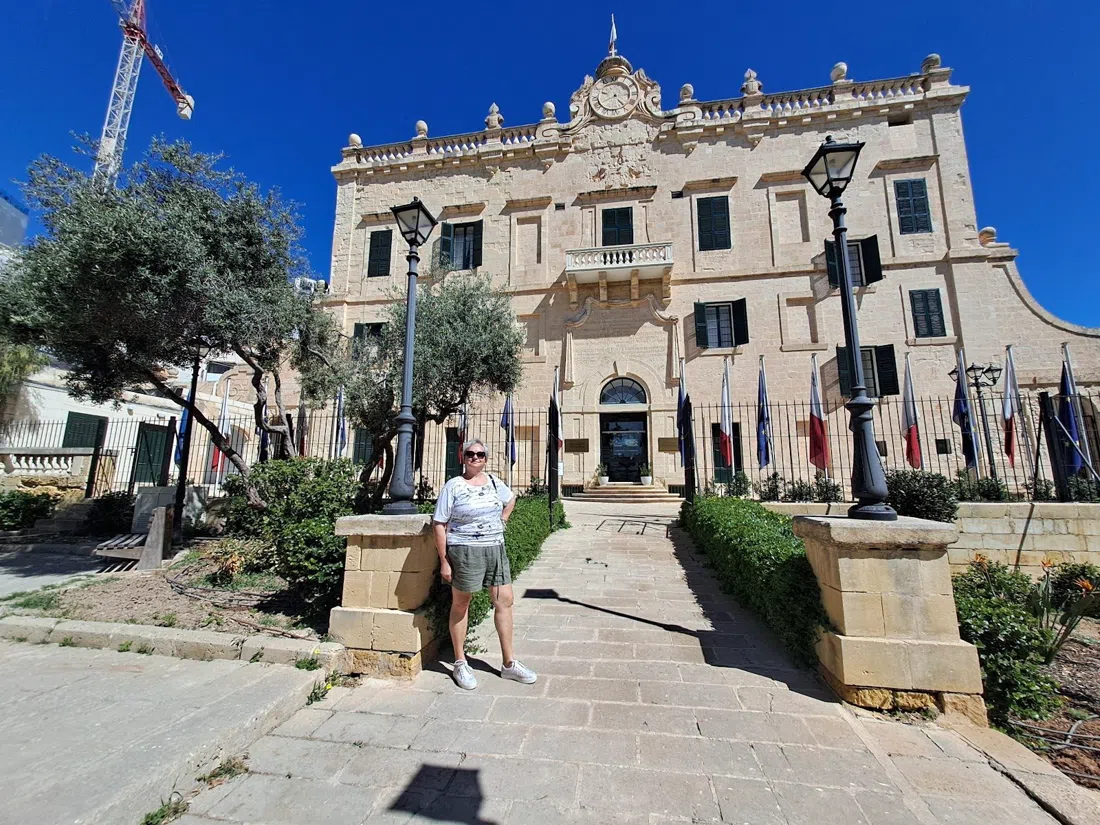
Turn up from the water onto Main Street for Spinola Palace Gardens (Main Street), which carries the most direct British thread on the walk. The palace bears an inscription saying it was built for the people's recreation; it then served as the British military Forrest Hospital from 1860 to 1922. The palace itself is closed, but the gardens were opened to the public in 2019 and there is a restaurant in the cellar, priced separately. Entry is free, there is a playground, and there is nothing to book. It is the easiest ten minutes on the route and a good place to put a group while two people queue for coffee.
Main Street to Balluta Square
Staying on Main Street, Barracuda Restaurant (194 Main Street) occupies an eighteenth-century summer villa, a wealthy family's drawing room, converted with an award from Malta's National Trust and serving Mediterranean fish for close to thirty years. It reads as the pre-resort St Julian's: a house built to look at the water by people who owned the water. Open daily roughly 11:00–23:00, around €45–75 a head. Reservations and group bookings are taken, and the rooftop lounge upstairs is the same operation rather than a separate venue, which is how larger parties are handled here. Book it, because it fills.
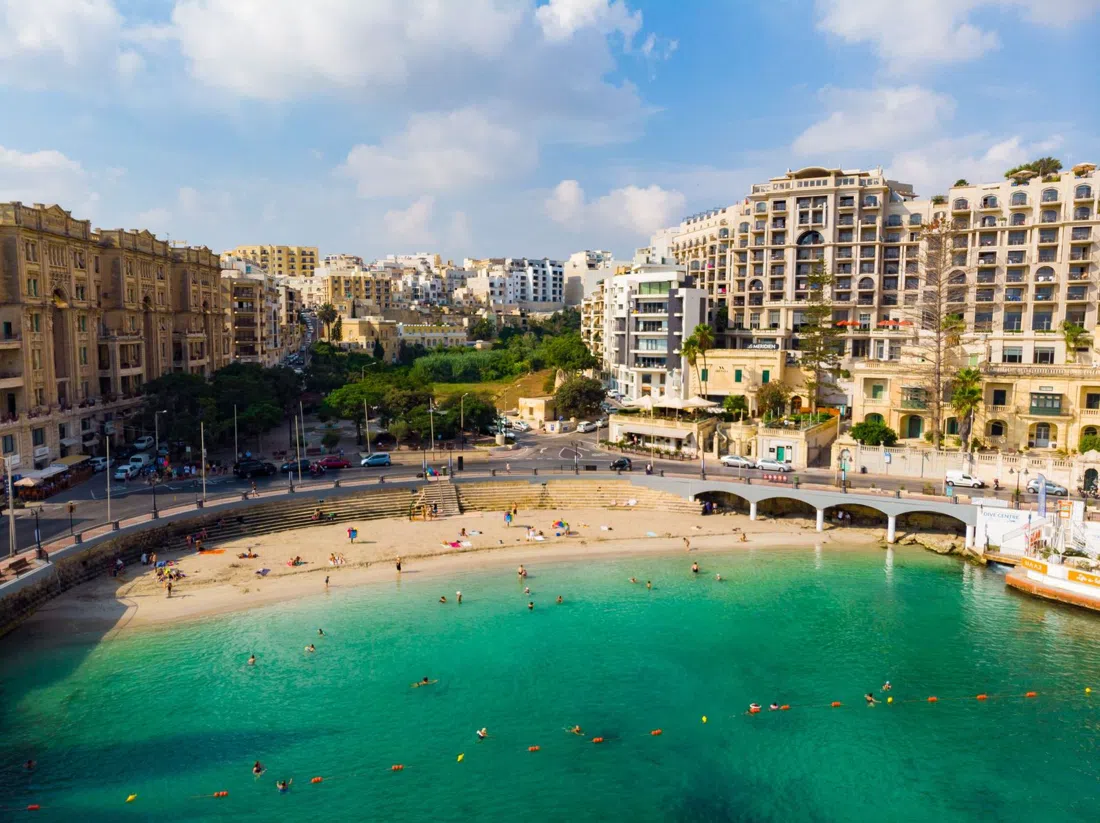
The walk ends at Balluta Square and Balluta Buildings (Balluta Bay), and this is the image the British package era printed on its postcards. The Art Nouveau block was built in 1928 for Marquis John Scicluna to designs by Giuseppe Psaila, and it is among the better-preserved work of its kind in Malta. The square is open public ground with no door policy, café tables outside are first-come, and coffee runs €2–4. Sit for twenty minutes and you have the view that sold the bay to a generation of visitors.
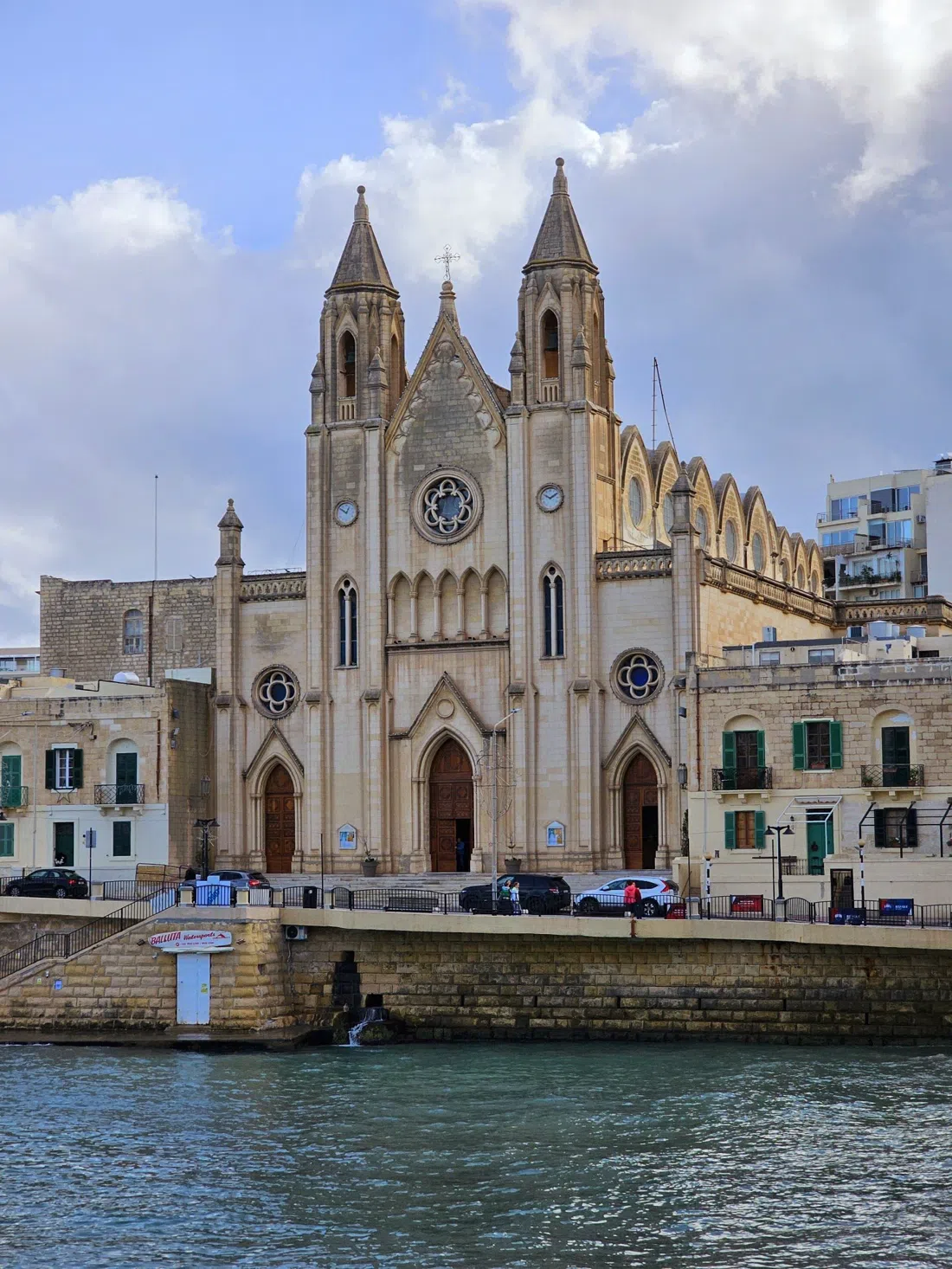
Above it stands the Parish Church of Our Lady of Mount Carmel (Balluta), rebuilt in 1859, again in 1877 and again in 1900, then enlarged in 1958 to its present form. The 1958 date matters for this walk: the silhouette the 1960s arrivals photographed is the one standing over the square now. It is a working parish rather than a monument. Groups are welcome outside service times, dress modestly, and keep it quiet if Mass is running. Time your visit around it rather than through it. Entry is free.
On the same shoreline, Malta Marriott Resort & Spa (Balluta Bay) sits in the grounds of a nineteenth-century villa. Use the current name when you book: this was Le Méridien St Julian's and remains listed under the old one in plenty of places. It runs 301 rooms, four restaurants, a squash court and a twelve-room spa, handles group blocks and events without strain, and costs about €150–350 a night.
Where the servicemen drank
This is the part of the story with nothing left to visit. The bars that the British servicemen and the first charter crowds actually drank in, the ones near Spinola and on the bay, have all closed, and none of them carries a plaque. Nobody preserved them, because nobody at the time thought a drinking hole full of sailors was heritage.
What stands in for them is The Dubliner (Paceville), an Irish pub a short uphill walk from the Balluta end of the route. It is pub-crawl territory, used to groups and loud at the front; the upstairs lounge is the quieter option if you want to hear each other. Around €12–25 a head. Treat it as a functional stand-in rather than a relic, and do not let anyone tell you the fittings are original.
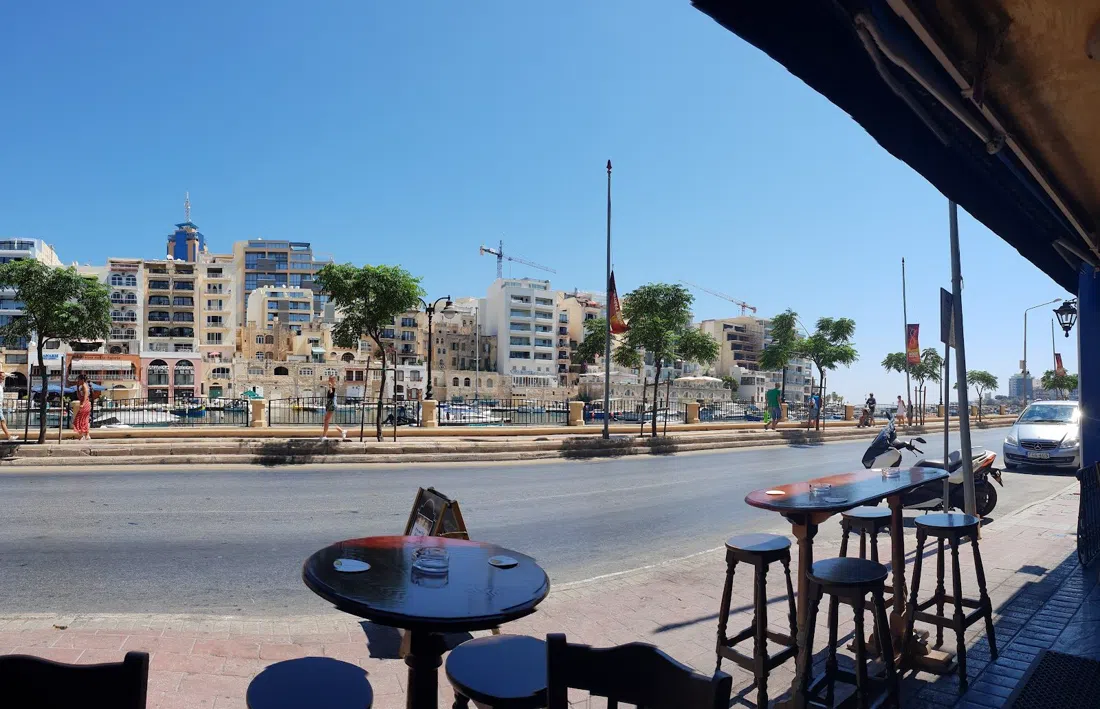
Three stops off the shoreline
Three things worth leaving the waterfront for, in increasing order of distance. Vintage Bus Tours put you inside the most tangible surviving object of the British era anywhere on the island, because Malta's old buses were British stock: Bedford, AEC, Leyland and Ford chassis, worked for decades and painted into local livery. The Green Route runs Monday, Wednesday and Friday to the old walled city inland and its neighbour; the Orange Route runs Tuesday and Thursday. Two operators, Zinnu and Supreme, run the vehicles between them. Expect roughly €25–40 per adult, and whole-bus charters are available, which makes this the simplest thing on this page to book for a group of thirty. Pickup is from the next seafront town along, a fifteen-minute walk or a short hop from St Julian's.

Half an hour up the north coast, the Malta Classic Car Collection is the pop-culture hardware of the invasion parked indoors: the cars the records were played in, kept in running order. Allow one to two hours, or three if you sit through the films and the simulator. Admission from around €12 per adult. Open Monday to Friday 09:00–17:00 and Saturday 09:00–14:00, closed Sunday. A street-level entrance, gift shop and Maltese café opened on 1 May 2026. Phone ahead on +356 21 578 885 for group rates.
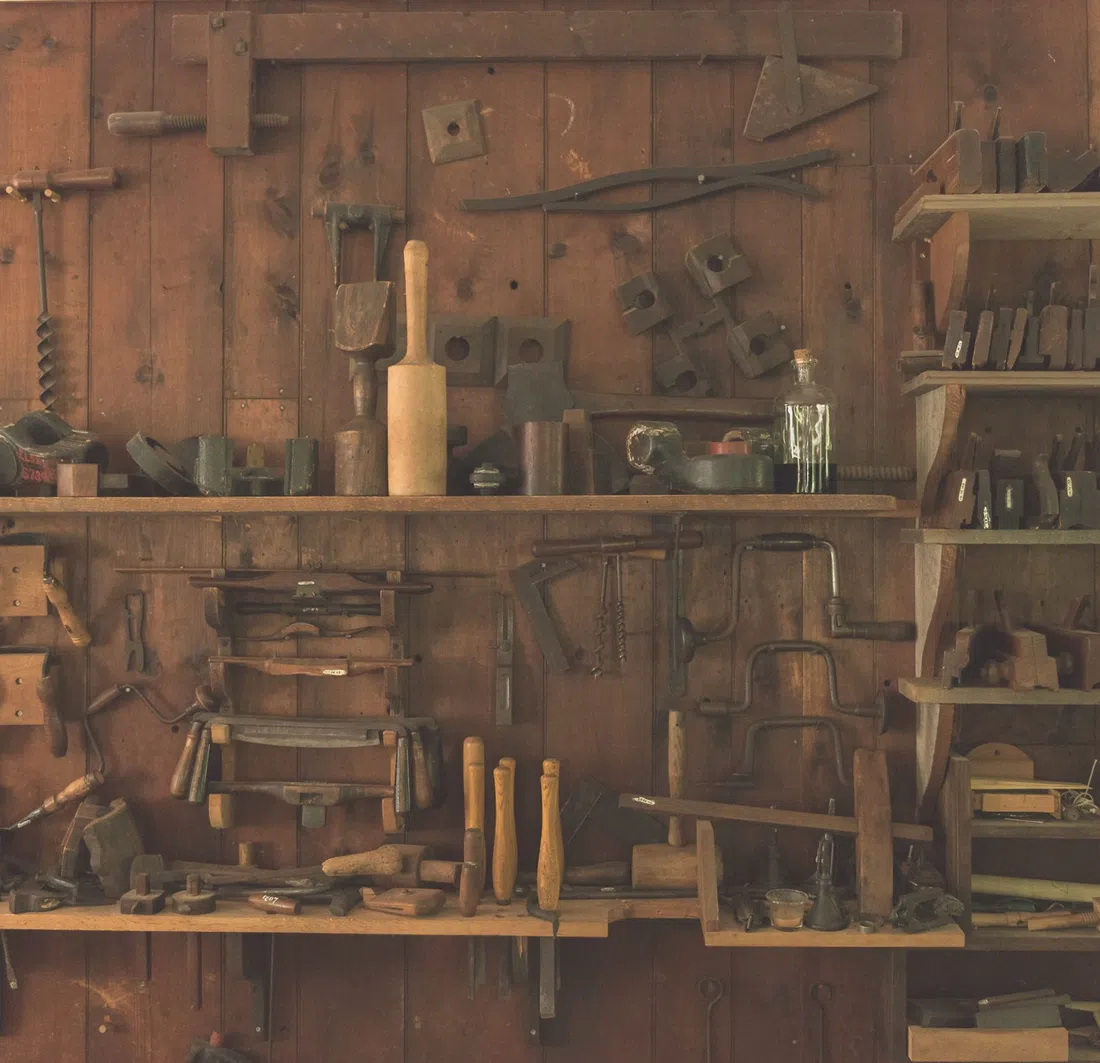
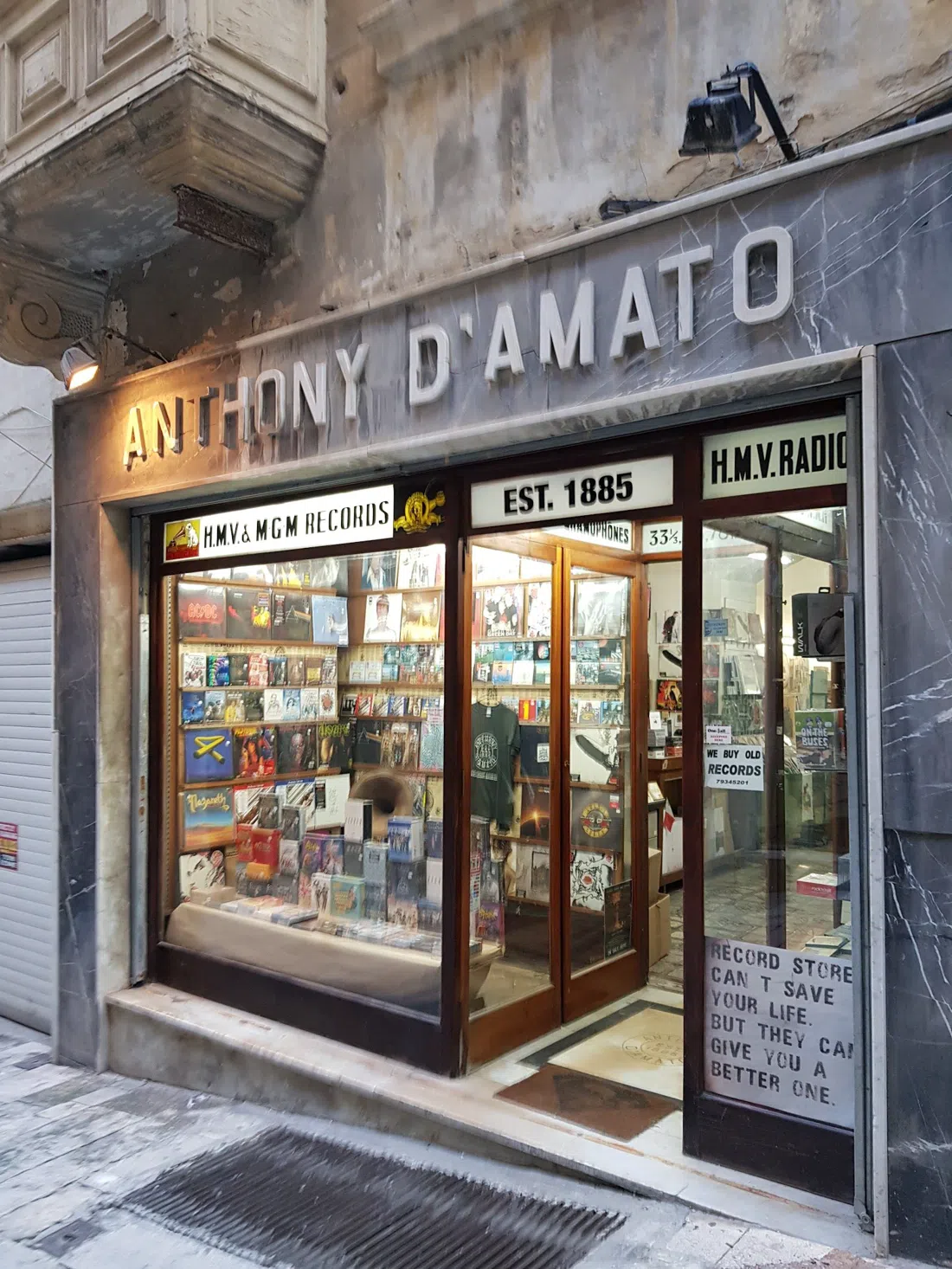
Finally, and about twenty minutes away in the capital, D'Amato Records is where the British pop records physically reached Malta. The shop was founded in 1885, has been run by five generations of the same family, is widely described as the oldest operating record store in the world, and cut the first Maltese songs to vinyl in the 1930s. Browsing is free and vinyl runs roughly €15–40. It is a small room, so go in twos and threes, not as a coach party.
Practical notes for the walk
The route from the Dragonara headland to Balluta Square is about two kilometres and takes forty minutes at a steady pace with no stops, or most of a day if you swim, eat and sit in the square. Pavements are continuous but the gradients off the water are steep in places, and the stretch past Portomaso is exposed at midday in summer. Walk it in the morning and keep the casino for the evening, when the dress code makes sense.
Buses are the only sensible public transport. The 13 and 14 run the coast road from the capital's terminus through the next seafront town into St Julian's, and the X2 airport express stops on the same strip, which is the easiest arrival if you land in the afternoon. Northbound coast services carry on past the stretch where the car museum sits. Routes and timetables are revised periodically, so check the current one rather than trusting any page, including this one, and if you are staying a week buy a travel card. Single tickets cost a couple of euros and are valid for two hours, but the card works out cheaper per trip.
Currency is the euro. Cards are accepted almost everywhere on the strip, but carry some cash for the square's café tables and small change for the record shop, and carry your passport or ID card if the casino is on the evening's list. Budget for one full day done properly: €40–45 for the lido pass, €2–4 for coffee in the square, €45–75 a head for dinner in the villa, €12–25 upstairs in the pub afterwards. Rooms along the route run from about €70 a night at the four-star end to €350 in high season at the big hotels. For the rest of the bay, including eating, nightlife and the Paceville end, see the St Julian's guide.