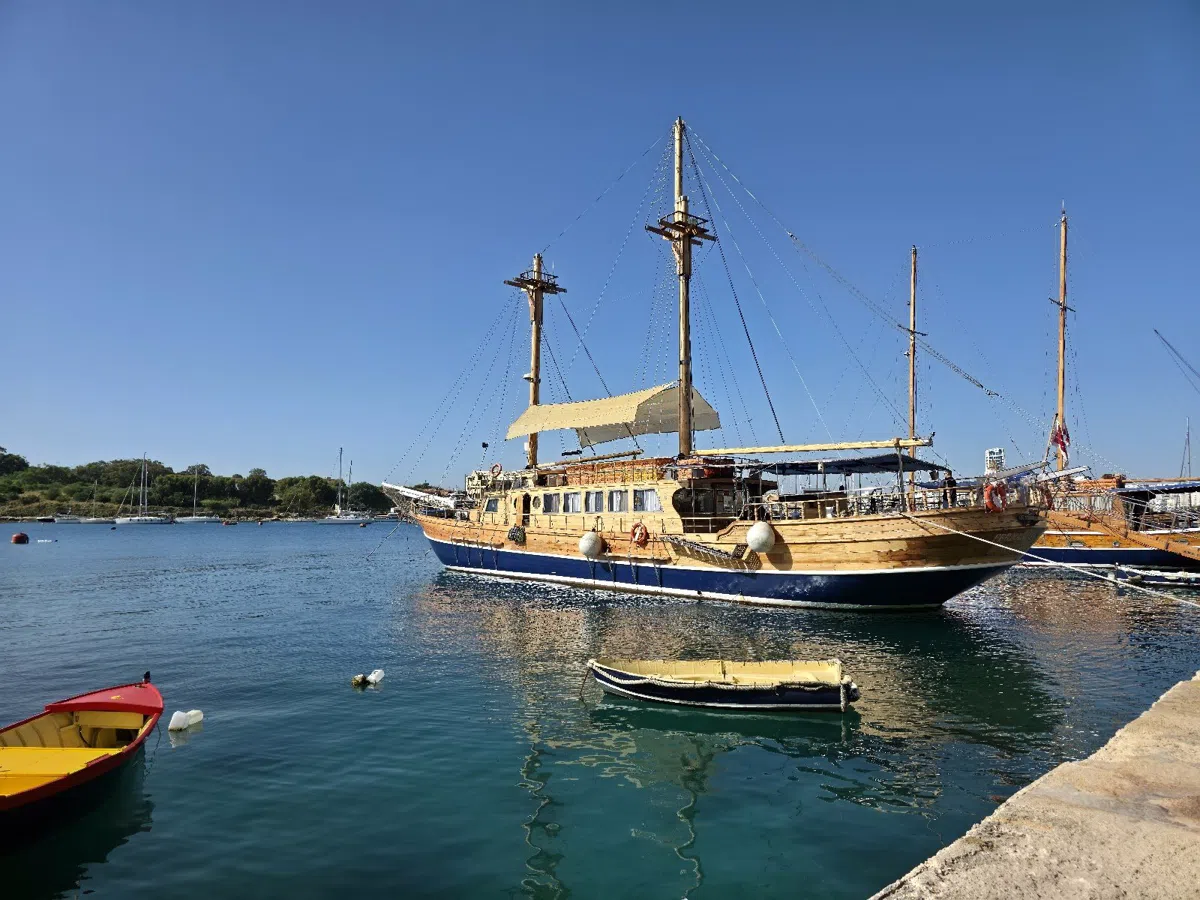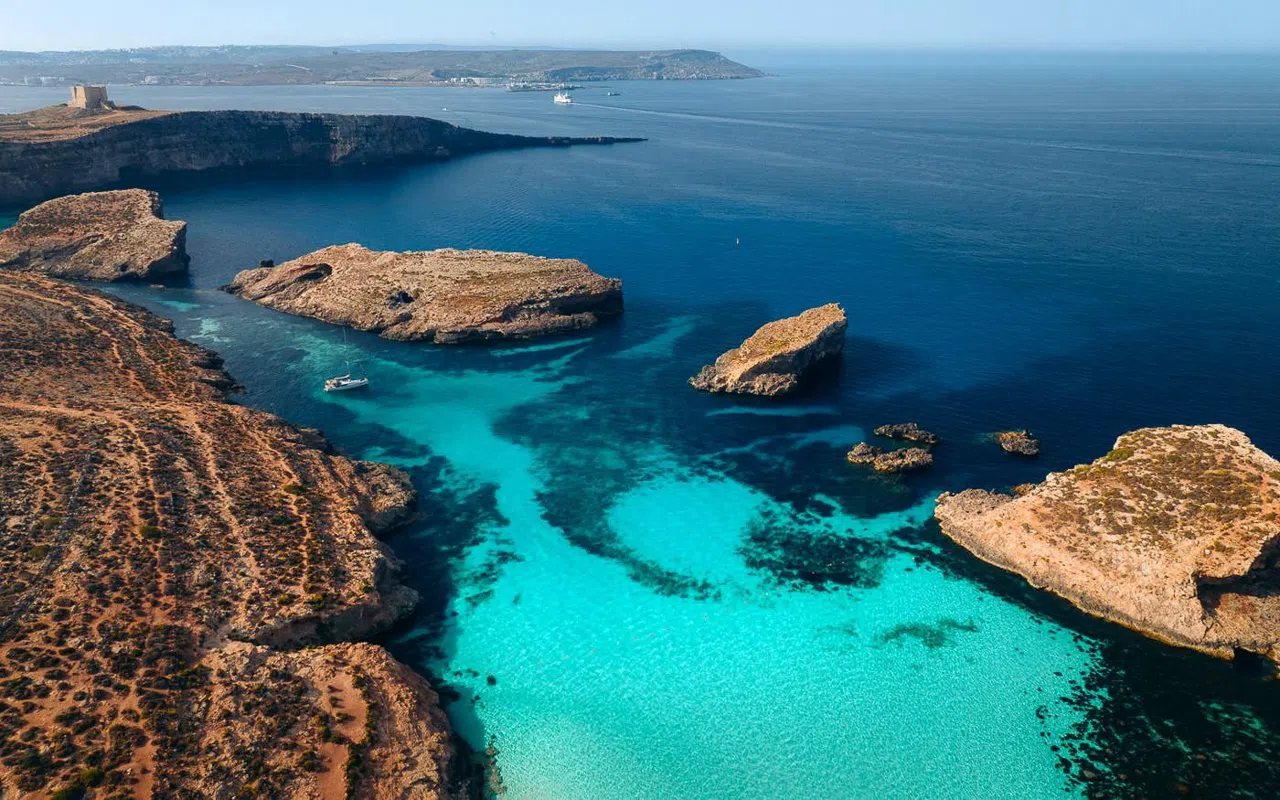

The boat out of Marfa Quay takes about forty minutes, and by the time it noses into Mġarr the tuk tuks are already lined up along the quay, six seats apiece, canvas roof, no doors. What follows is a loop rather than a route march: clifftops, a basilica, a working salt pan, an hour over lunch, and then back onto the water for the swim most people actually booked the day for. Gozo is roughly fifteen kilometres end to end, which is the only reason a vehicle capped at forty kilometres an hour can show you most of it and still get you home.
What the tuk tuk day actually is
Underneath the marketing this is a small-group road tour with a boat at either end. Yippee (Triq ix-Xatt, Għajnsielem) runs the vehicles, and Gozo's official tourism site names it as the only company operating tuk tuks on the island, so whichever badge you book the day under, these are the tuk tuks that turn up. Six passengers to a vehicle, forward-facing, driver at the front. Larger parties get split across several tuk tuks travelling in convoy, which works on the road and works less well at the stops, where fifteen people arrive at a viewpoint built for four. Drivers work in English, French, German, Italian, Polish, Spanish, Dutch and Arabic; ask for the language at booking rather than on the quay.
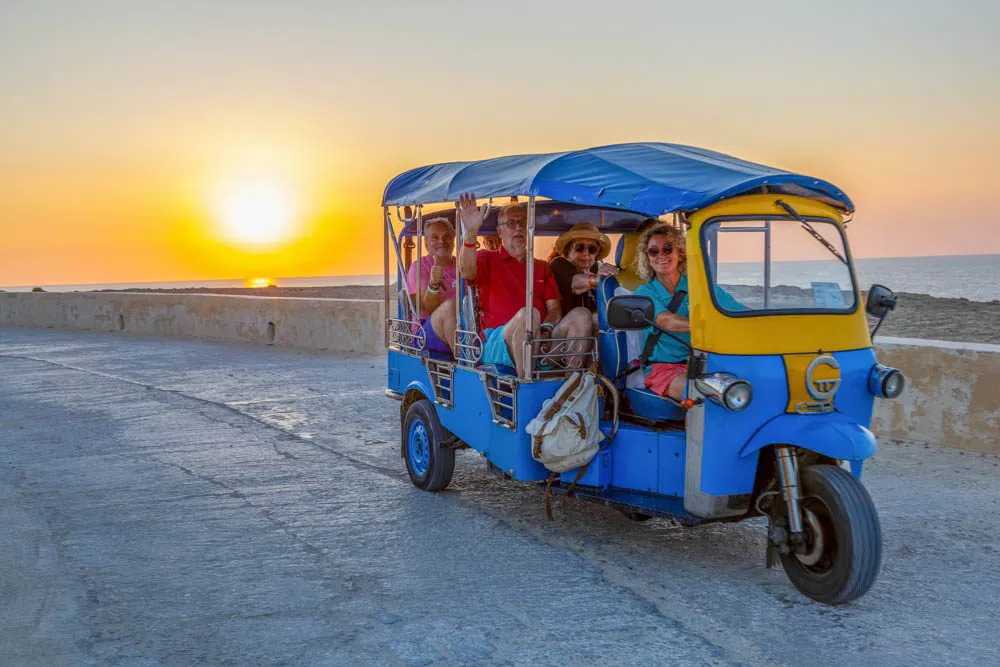
The full day with lunch and the boat included runs at around €79 for an adult and €55 for a child, with a deposit taken at booking. Bought as a packaged day from Malta with hotel pickup and both crossings folded in, it starts from 100 USD per person. The guided version runs seven days a week, and the tour most people book holds a 4.7 out of 5 rating from 1,792 traveller reviews. That is a fair description of what it is: a well-drilled day that covers a lot of ground and lingers nowhere.
The tuk tuks are not wheelchair accessible, and there is no version of the day that works around that. They are also open-sided, so you get sun, wind and road dust for six or seven hours, and a hat, sunglasses and something with sleeves matter more than they sound.
Getting out of St Julian's
The tour boats leave from Marfa Quay, beside Ċirkewwa Ferry Terminal (northern Malta) at around 09:30, once the hotel pickups have finished their rounds. Pickup order is not in your control, so if you are at the far end of the run you will be on the minibus a while before you are on the water. Staying central shortens that; the St Julian's hotel search is the place to start if you have not booked a room yet, and it is worth giving the operator your exact hotel name rather than the area.
The crossing is easy enough to do yourself. The Gozo Channel ferry leaves from the same terminal 24 hours a day, every 30 minutes through the daytime, and takes about 25 minutes. A foot passenger pays €4.65 return and children aged 3 to 12 pay €1.15, collected at Mġarr on the way back rather than on the way out. From St Julian's the 222 is the coast route north to Ċirkewwa; allow well over an hour, more in summer traffic, and check the first departure against the ferry you want. Done independently, the water costs close to nothing. What the tour is charging for is the vehicle at the other end, the boat to Comino, and somebody else holding the clock.
The first hour out of Mġarr
Mġarr Harbour (Għajnsielem) is where the day starts and ends: open quayside, no restrictions, free, and the one stop with a promenade worth walking. If the boat back is delayed there is a small swimming spot at Iz-Zewwieqa at the far end, which beats standing by the ticket window for twenty minutes.
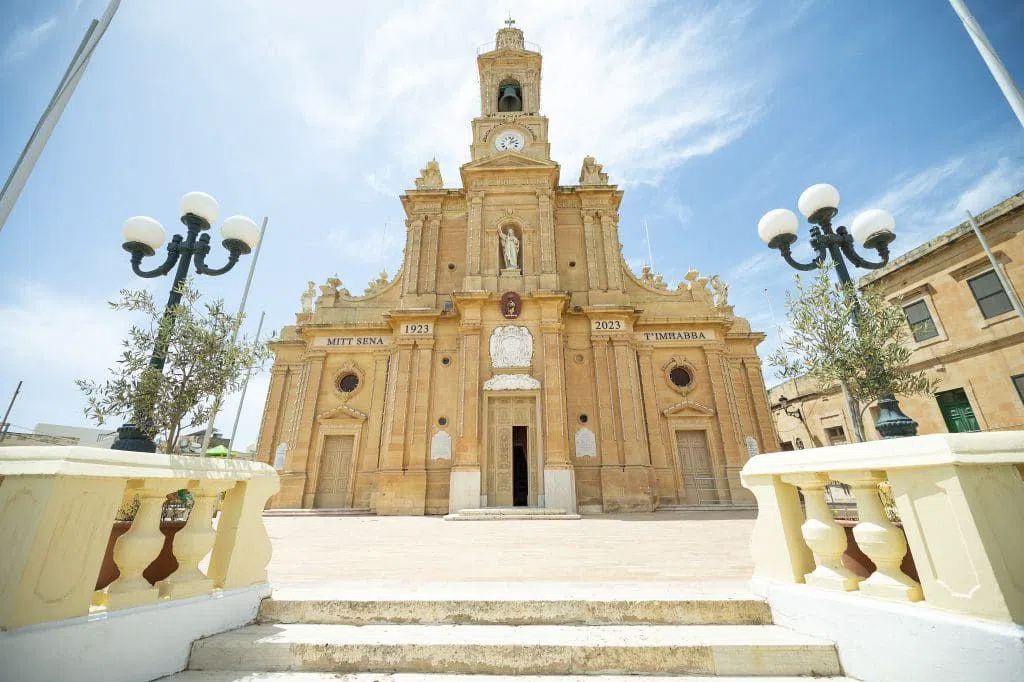
The first stop out of the harbour is usually the Rotunda of St John the Baptist (Xewkija). The church is free and about €3 buys the lift up to the belfry gallery, which is worth taking: you get the whole island laid out before you have driven any of it, and the rest of the day makes more sense for it. Modest dress applies, as in any working church.
A few minutes on, L-Għajn tal-Ħasselin, the Knights' Wash-House (Fontana) is a sixteenth-century communal wash-house still fed by its spring, sitting directly on the roadside. It is free and accessible around the clock, and it is a five-minute stop with nowhere for a group to spread out. It is also the stop that explains how Gozitans actually lived before any of this was a tour.
Cliffs, Xlendi and the citadel
Sanap Cliffs (Munxar) is the standard first clifftop of the loop: wide open ground, fine for a group, with very limited parking, which is one of the arguments for arriving in something small. There is no barrier at the lip. Keep children close, and do not step backwards for a photograph.
Down the hill, Xlendi Bay (Munxar) is a natural swimming basin rather than a sandy beach, with restaurants along the waterfront. On the tuk tuk loop the stop is photo-length, not swim-length. If you want to eat here properly, budget roughly €20 to €40 a head and come back under your own steam. The promenade tables are tight in summer and a convoy of fifteen will not be seated quickly.
Iċ-Ċittadella (Victoria) is where the day's timing bites hardest. The walled town is free-flow and absorbs any group size; the ramparts and lanes cost nothing and the views off them are the main event. The five museums inside (the Visitors' Centre, the Archaeology Museum, the Nature Museum, the Old Prisons and Gran Castello Historic House) are covered by a €5 combo ticket, open Tuesday to Sunday 09:00 to 17:00 with last entry at 16:30, closed Mondays. A convoy stop rarely leaves long enough to use that ticket properly, and the narrow doorways and timed capacity inside mean a group will not move through together. If the museums are the reason you wanted Gozo, give the citadel its own trip.
Ta' Pinu and the west coast
Ta' Pinu National Shrine (Għarb) opens roughly 07:00 to 19:00, costs nothing, welcomes donations, and enforces a shoulders-and-knees dress code. That catches out anyone who has already changed for the Comino swim, so carry a light layer in the day bag from the start. It handles groups and coach pilgrimages without strain and is quieter outside service times.
Dwejra (San Lawrenz) covers the Inland Sea, Fungus Rock and the site where the Azure Window stood. The arch collapsed in a storm in 2017 and is genuinely gone. There is nothing at the spot to photograph, and it is better to know that before you arrive. What remains is the tunnel boat: fishermen take four to eight people at a time out through the cliff passage to the open sea and back, about twenty minutes, roughly €4 in cash. The boats leave when they are full, so a party of fifteen splits across three of them and reconvenes on the slipway. Between November and March, Gregale winds suspend the boats regularly. Walking in to the Inland Sea and out along the Fungus Rock headland stays free and open either way.
Lunch, salt and the north coast
Marsalforn and Qbajjar Bay is the standard lunch halt, and the included traditional Gozitan lunch usually lands here. It is Gozo's main resort village, several waterfront restaurants seat groups without fuss, and the food is pleasant and unremarkable. À la carte runs roughly €15 to €35. Treat it as the one hour of the day when you are not moving.
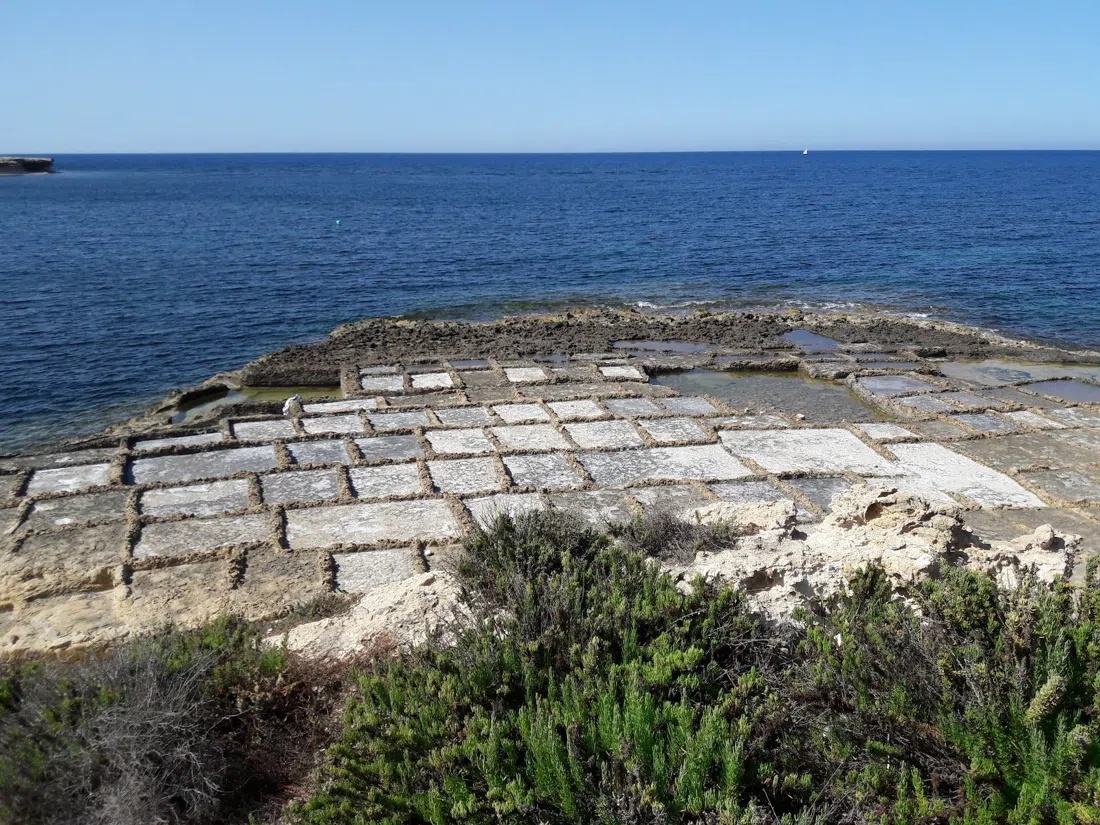
A short run west, the Xwejni Salt Pans (Żebbuġ) are worked by the Cini family, who meet visitors at the rock-cut shop and will explain the trade if you ask. This is a 350-year-old working business, not an exhibit. Harvest runs from mid-May to early September, looking costs nothing, bagged sea salt is a few euro, and the single rule is that nobody walks on the pans. Groups and educational visits are taken by appointment.
The Calypso Cave viewpoint above Ramla Bay (Xagħra) is a small clifftop platform. The cave itself has been fenced shut for years on geological safety grounds, so tell anyone in your party who has read the Odyssey that before they climb up. What you get is the view over Ramla's red sand, which is the reason to stop. The platform suits a tuk tuk-sized group and does not suit a coach; the beach below absorbs any number of people.
Ġgantija and the add-on question
Ġgantija Archaeological Park (Xagħra) is the megalithic temple complex that predates Stonehenge and the pyramids, and on a tuk tuk day it is almost always an optional paid extra rather than part of the price. Entry is €10 for an adult, €8 for youth, seniors and students, €6 for children aged 6 to 11, and free for children aged 1 to 5; the same ticket covers Ta' Kola Windmill, two minutes away. Opening is daily 10:00 to 18:00 from March to December, and 09:00 to 17:00 with Tuesday closures in January and February. The walkway is single-file in places, so a convoy filters through slowly. Ask at booking whether it is in or out. If it is out and you want it, that is €10 and about forty minutes you need to have claimed in advance.
The Blue Lagoon and the pass you need to land
Blue Lagoon (Comino) is the headline stop and the reason the day is sold as a full day rather than a half. The water is the colour it is in the photographs. What has changed is the access. Since May 2025 the lagoon has been capped at 4,000 people at a time across three daily slots (08:00 to 13:30, 13:30 to 17:30 and 17:30 to 22:00), and every person stepping ashore needs a free timed Access Management System pass. The QR code arrives by email and is scanned for a wristband on landing. The pass costs nothing. Landings are limited by the passes rather than by boat space.
That is worth understanding before you pay. Boats whose passengers hold no passes can still anchor off and let people swim from the boat; they simply cannot land anyone. A number of operators run it exactly that way, and an hour swimming off the anchor in that water is no hardship, but it is not the same as walking ashore, and you should know which one you have bought. Ask the operator directly whether passes are issued for your party and for which slot, then check your own inbox for the QR before you leave the hotel.
The crossing costs €10 to €15 on the public ferry, €20 to €45 on a group boat and €40 to €80 for a private charter. The lagoon itself is free, and the landing pass is free.
Best time to go
April to June and mid-September into October are the straightforward months: the water is warm enough to swim, the tuk tuk is bearable in open air, and the light at Sanap and Dwejra is usable most of the day. July and August work, but an open-sided vehicle in full Mediterranean sun is a long day for small children, and the lagoon is where the crowd cap is most likely to shape your slot.
Winter changes the shape of the day rather than cancelling it. Gregale winds suspend the Dwejra tunnel boats regularly between November and March, the sea crossing to Comino is weather-dependent, and the tuk tuk is cold with the wind coming over the cliffs. In return the citadel and Ta' Pinu are quiet, and you can use the €5 combo ticket without queueing.
Day of the week matters more than people expect. The Ċittadella museums are closed on Mondays, and Ġgantija closes on Tuesdays in January and February. A Monday tour is a perfectly good coastal day but a poor one for anyone who came for the interiors. The salt pans are at their most interesting during the harvest, mid-May to early September. And on time of day: the morning lagoon slot from 08:00 gives you the water before the boat traffic builds, which is the single best argument for an early pickup out of St Julian's.
Booking ahead or turning up
There is no ticket window to walk up to here, so 'at the door' really means arranging it on Gozo the same morning, and that depends on whether a vehicle in the fleet happens to be free. Given the size of a tuk tuk, six seats, a party of four or more is unlikely to be slotted in on the day in high season. A guided version of this day operates seven days a week, so the question is rarely whether it runs, only whether your date still has space on it; book it far enough out that the answer is straightforward, and check the cancellation terms, because both boat legs are weather-dependent.
If you would rather assemble the day yourself, it is entirely doable: the ferry runs every half hour, the public boat to Comino is €10 to €15, and Gozo's buses all radiate from the terminus in Victoria, which usually means one change for any cross-island hop. What you will spend is time. The independent version of this itinerary is a two-day job, not a one-day job.
Is it worth it
For a first visit to Gozo with one day to spend, yes, with a qualification. You are buying coverage and logistics, not depth. You will see the cliffs, the citadel walls, the shrine, the salt pans, the tunnel boat and the lagoon inside one day, and you will get roughly ten minutes at most of them. That suits couples, mixed-age families with children old enough to sit still in an open vehicle, and anyone who wants the island's outline before deciding where to come back to properly.
It does not suit wheelchair users, because the vehicles cannot take a chair. Anyone whose main interest is the museums should skip it too, since the citadel and Ġgantija both want more time than the loop allows. And it is wrong for people who want a long, slow swim: the lagoon stop is an hour or so of a seven-hour day. If the Blue Lagoon is the only thing you want, a direct boat and a landing pass is the cheaper, better answer.
Practical notes
Transport: the 222 is the coast route north from St Julian's to Ċirkewwa, and you should allow well over an hour. The Gozo Channel ferry runs 24 hours, every 30 minutes by day, 25 minutes crossing, €4.65 return for a foot passenger and €1.15 for children aged 3 to 12, paid at Mġarr on the return. Packaged tours collect from hotels and leave Marfa Quay around 09:30.
Carry €30 to €50 in small notes and coins per person. The Dwejra tunnel boat is about €4 cash, the Xewkija belfry lift about €3, the salt shop takes a few euro for a bag, and the citadel combo is €5. Card acceptance at the small stops is not something to rely on.
Allow roughly seven hours from pickup to drop-off for the packaged day. Get the Blue Lagoon slot confirmed in writing, and confirm whether your booking includes landing passes or an anchor swim.
On budget, done independently: about €4.65 for the ferry, €10 to €15 for the Comino boat, €5 at the citadel, €10 at Ġgantija, €4 for the tunnel boat, plus lunch at €15 to €35. Guided: around €79 adult and €55 child on Gozo with lunch and boat, or from 100 USD per person packaged from Malta with pickup.
Bring swimwear under your clothes, a light layer that covers shoulders and knees for Ta' Pinu, sun protection for an open vehicle, and shoes you can walk a rampart in.
For where to eat, drink and stay either side of the day, see the St Julian's guide.